

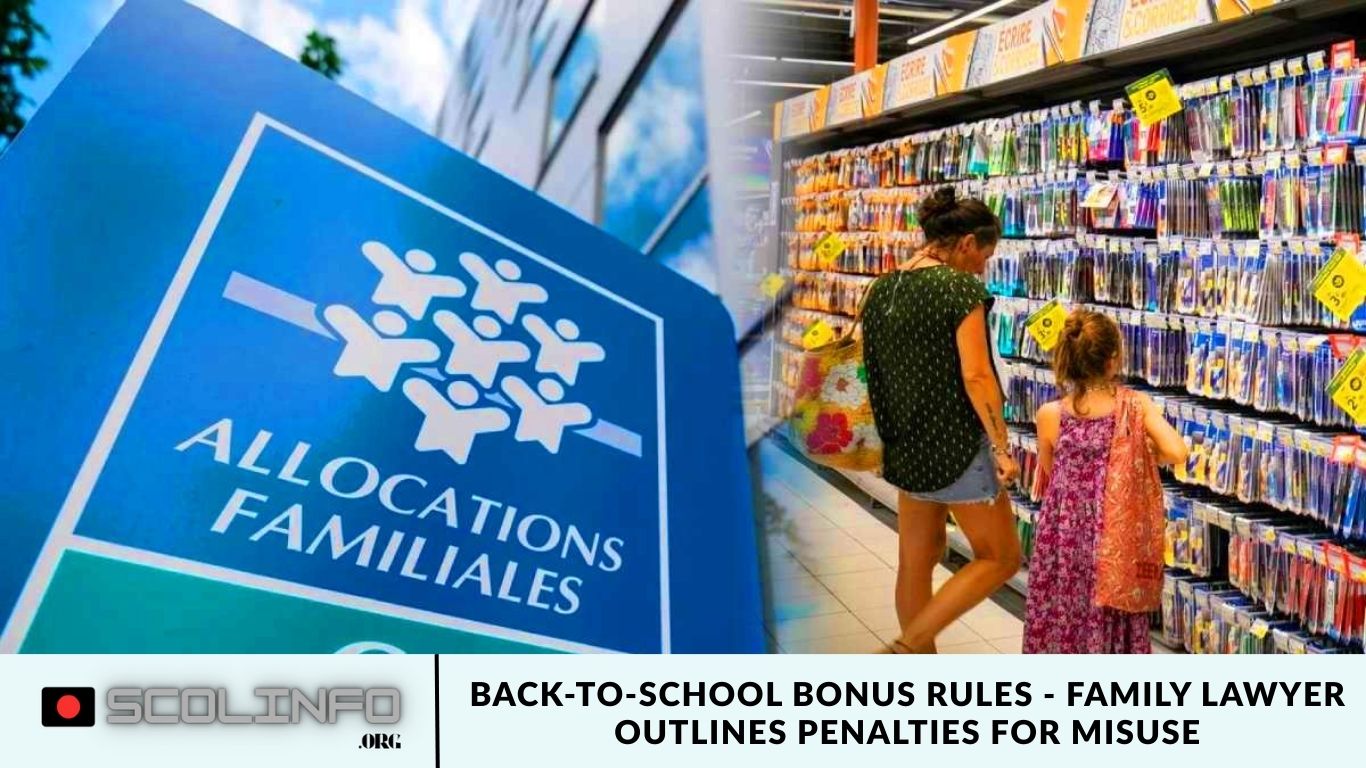
As families across the country prepare for the annual school supply rush, a new warning from a family lawyer is sparking debate over how the back-to-school allowance can be used.
Each summer, the Family Allowance Fund (CAF) distributes the back-to-school bonus to support low-income households with the rising cost of education. Traditionally, this aid helps parents purchase essential school supplies such as notebooks, backpacks, and uniforms. But this year, the conversation isn’t about the allowance amount it’s about how families are spending it.
According to Adrien Vallet, a family law specialist, parents who use the allowance for anything outside of school-related expenses could face legal consequences. His remarks, widely shared in the media and across social platforms, have fueled uncertainty and distrust among recipients of the bonus.
With rumors spreading quickly online, the situation raises an important question: Are families truly at risk of penalties if they don’t use the allowance strictly for school supplies, or is this a misunderstanding amplified by media coverage?
A controversial statement
According to Maître Adrien Vallet, a family law attorney based in Lyon, the Family Allowance Fund (CAF) has the right to intervene if there is suspicion of misuse of the back-to-school allowance (ARS). “For example, if a family openly resells the ARS or spends it on cigarettes or leisure activities unrelated to education, this may be considered an abuse of rights,” he explains.
Vallet’s remarks quickly sparked widespread debate on social media. Some criticized the idea as an invasion of privacy, while others argued that stricter monitoring was justified given the social purpose of the allowance.
The lawyer clarifies, however, that CAF does not systematically monitor how families spend the aid. “I’m not saying that CAF tracks every purchase. But legally, if fraud or clear misuse is proven, CAF can request an explanation or, in very rare circumstances, launch recovery proceedings,” Vallet notes.
When approached directly, the Family Allowance Fund delivers a more measured perspective. Officials emphasize that there is no legal obligation requiring families to justify how they spend the ARS. In practice, controls specifically targeting the back-to-school bonus are extremely rare, making strict enforcement more the exception than the rule.
No supporting documents required despite rumors
It’s easy to assume that the back-to-school allowance (ARS) might come with strict accounting requirements. A recent TikTok video, which went viral with over a million views, claimed that starting September 2025, all purchases made with the ARS would require proof of receipt. Authorities have categorically denied this claim. No official decree mandates such a rule.
Consulting the CAF guidelines provided to beneficiaries confirms this clarification. The documents clearly state the purpose of the ARS to support school-related expenses but make no mention of systematic monitoring or the requirement of mandatory receipts. The allowance is issued as a one-time payment, is not taxable, and does not require renewal, giving families full flexibility in managing the funds within their intended purpose.
Proper use in the vast majority of cases
Data from the Observatory of Inequalities, validated by the Court of Auditors, shows that 95–99% of recipients of the back-to-school allowance (ARS) spend the bonus on school-related expenses. The breakdown highlights the intended use of the funds:
- 99% purchase school supplies such as notebooks, backpacks, and stationery
- 95% buy back-to-school clothing or shoes
- Less than 2% of spending goes toward non-school-related items.
These statistics confirm what the CAF has consistently reported over the years: the ARS is overwhelmingly used appropriately. In 2025, the updated allowance amounts represent a strong commitment to supporting families amid ongoing inflation, ensuring that children’s educational needs are met without financial strain.
Amounts and conditions of the ARS for 2025
| Child’s age | Amount paid |
|---|---|
| 6 to 10 years old | €423.48 |
| 11 to 14 years old | €446.85 |
| 15 to 18 years old | 462.33 € |
To qualify for the back-to-school allowance (ARS), a household’s income must not exceed specific resource ceilings, which are determined based on the number of dependent children.
| Number of children | Annual ceiling 2023 |
|---|---|
| 1 child | €28,444 |
| 2 children | €35,008 |
| 3 children | €41,572 |
| 4 children | €48,136 |
| per additional child | +6,564 € |
What the law really says about the use of the bonus
Under the Social Security Code, there are no specific sanctions for using the back-to-school allowance (ARS) on non-school-related items, provided there is no evident fraud or false declaration. While the CAF has the authority to audit social benefits when abuse is suspected, such reviews cover the entire social benefits file, not the ARS specifically.
This means that no family has been penalized for spending the allowance on items like a television or a barbecue, even if such choices may attract attention. The focus remains on preventing fraud, rather than strictly controlling how families spend their educational support.
FAQ’s
What is the back-to-school bonus (ARS)?
The ARS (Allocation de Rentrée Scolaire) is a one-time financial allowance provided by the CAF to help low-income families cover the cost of school supplies, clothes, and other education-related expenses.
Who is eligible to receive the ARS?
Households whose income does not exceed specified ceilings, determined by the number of dependent children, are eligible for the bonus.
Are there rules on how the ARS must be spent?
Yes. The allowance is intended for school-related expenses, including supplies, clothing, and shoes. Spending outside of these areas is strongly discouraged, but it is generally not legally penalized unless fraud is involved.
Can the CAF impose penalties for misuse of the ARS?
According to family law experts, the CAF can investigate cases of obvious fraud or false declarations. However, routine purchases outside school needs do not typically result in sanctions.
Does the CAF monitor every ARS purchase?
No. Systematic monitoring of individual purchases is not conducted. CAF audits social benefits only in cases of suspected abuse, which concerns the full benefits file rather than just the ARS.
Is there a legal requirement to keep receipts for ARS spending?
No official decree mandates receipts for ARS purchases. Viral social media claims suggesting such requirements have been categorically denied by authorities.
What percentage of families use the ARS correctly?
Data from the Observatory of Inequalities, validated by the Court of Auditors, indicate that 95–99% of beneficiaries allocate their allowance to school-related expenses, such as supplies, clothing, and shoes.
Conclusion
The back-to-school bonus (ARS) remains a vital support for low-income families, helping ensure children have the necessary school supplies, clothing, and educational resources. While the CAF has the authority to investigate obvious fraud or misuse, most families use the allowance responsibly, with studies showing 95–99% of beneficiaries spend it on school-related items.
